
Inside Calendly’s $3B Growth Playbook
Calendly’s growth playbook and what every founder and PMMs can steal from it.

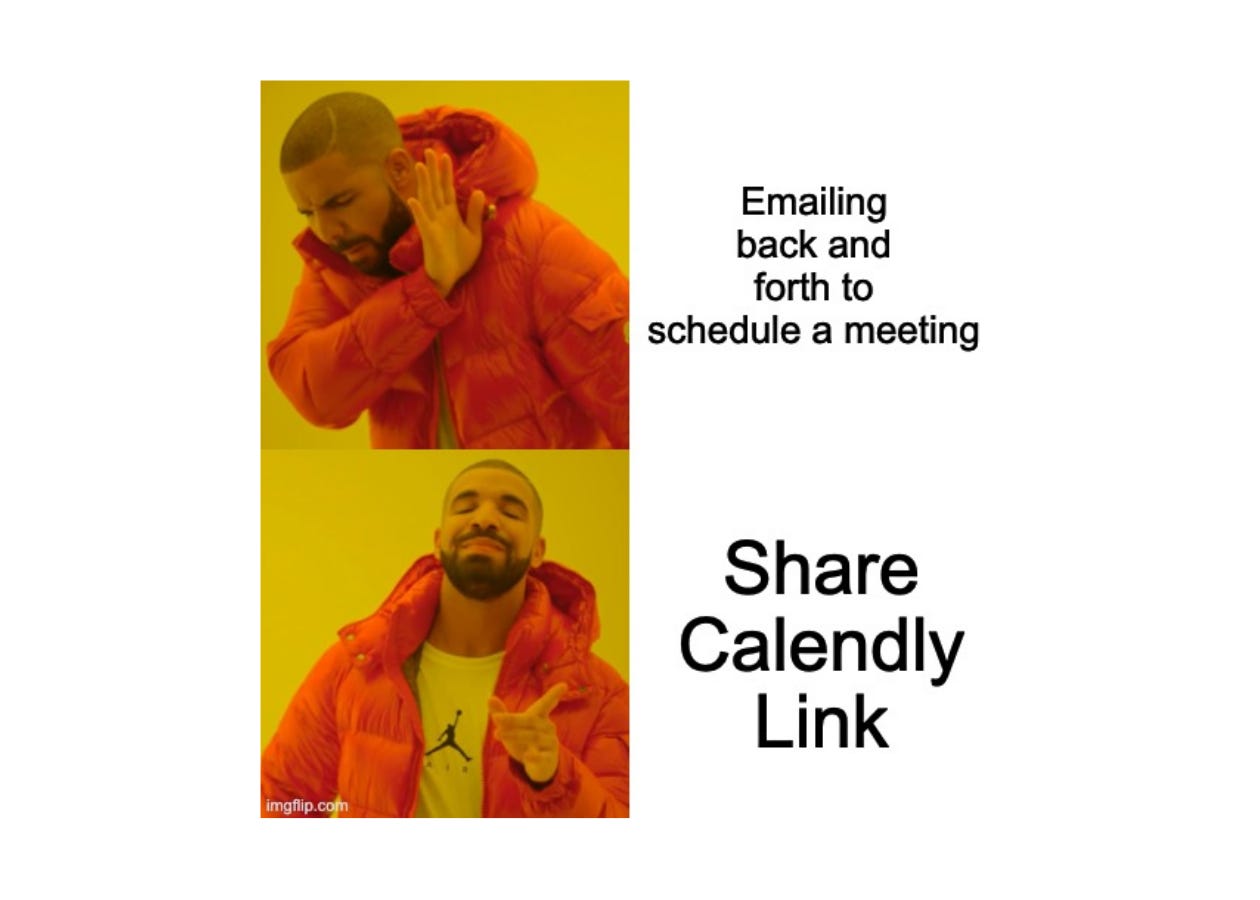
We’ve all been there. You’re trying to schedule a meeting.
You send three time options.
They reply with three that don’t work.
Add in time zones, reschedules, and back-and-forth chaos…
Scheduling used to be a nightmare. Calendly made it effortless — one link, problem solved. That simplicity turned into a product-led growth engine powering a $3B+ company.
Here are 7 GTM lessons from Calendly’s playbook that founders and marketers can steal.
1) Free as a Growth Engine
Inside Calendly, one of the biggest internal debates has always been around the free plan.
The sales team often pushed to tighten it — suggesting limits like shorter trials, fewer features, or usage caps.
Their reasoning? When prospects already had the free version, it made upsells harder. In their eyes, free was the “competition.”
But leadership took the opposite stance. Since 2014, Calendly has never taken anything away from free users — only added more. Why? Because free fuels their growth flywheel:
Every free link shared is a distribution channel.
Free users act like a marketing team, showing off the product in every booking.
Paid upgrades happen naturally once users hit team features, branding, or advanced workflows.
👉 Lesson: Protect your free tier. It might frustrate sales in the short term, but it compounds into long-term growth.
2) Finding the Real Power Users: Sales, Recruiting, CS
Calendly could have gone broad: “anyone who schedules meetings.” But not all meetings are created equal.
They realized external-facing teams (sales reps, recruiters, and customer success managers) were the real power users. Why?
They schedule constantly.
Every meeting ties directly to revenue or talent acquisition.
They need professionalism and reliability at scale.
For these teams, Calendly isn’t just a convenience tool. It’s part of their customer acquisition stack, the first touchpoint with a prospect or candidate.
👉 Lesson: Find the segment where your product is tied to revenue, not just productivity. Those are the users who will pay and expand.
3) The Scheduling Flywheel: How Every Link Creates a New User
Calendly’s growth wasn’t fueled by ads. It was fueled by a flywheel.
Someone receives a Calendly link.
They schedule a meeting in seconds.
They think: “That was painless.”
They sign up and send their own link.
Repeat.
Internally, Calendly measures this with two north star metrics:
Meetings → Signups
Signups → Activation (defined as 5+ people booking with you)
That’s when scheduling with Calendly becomes a habit. Even as conversion rates naturally declined at scale, the sheer number of meetings in the funnel kept growth compounding.
👉 Lesson: Optimize for viral loops, not just top-line signups. If every action creates another user, growth becomes exponential.
4) Walking the Tightrope Between PLG and Enterprise Sales
Calendly is a PLG giant: 90% of revenue still comes from self-serve. But the remaining 10% (enterprise expansion) is crucial for long-term growth.
Finding that balance wasn’t easy.
In the “growth at all costs” era, Calendly scaled its sales team fast. Revenue grew, but so did CAC, and many enterprise deals simply cannibalized PLG conversions that would’ve happened anyway.
In other moments, they understaffed sales and left seven-figure opportunities on the table because no one was available to manage procurement, integrations, and compliance.
The sweet spot? Most users self-serve. Sales steps in only when the deal truly requires it: rolling out across thousands of employees, navigating procurement, or integrating into Salesforce.
👉 Lesson: Hybrid GTM is a balancing act. Use sales to amplify PLG, not replace it.
5) Fighting Google and Microsoft — and Still Winning
By now, Google and Microsoft have added their own scheduling tools. On paper, that should have crushed Calendly.
But here’s the difference:
Google/Outlook: “Basic scheduling”
Calendly: “Revenue-driving scheduling”
Calendly wins by owning the workflow, not just the feature. External-facing teams need:
Branded booking pages that feel professional.
Deep integrations into their sales and marketing stack.
Reliability at scale, with analytics to measure impact.
It’s the difference between a bundled “good enough” tool and a platform that ties directly to business outcomes.
👉 Lesson: Don’t fight bundled features head-on. Win by embedding into workflows where “good enough” fails.
6) Going Upmarket Without Making the Product Bloated
The risk of moving upmarket is always the same: bloat.
Enterprise customers need integrations, compliance, change management — things that can easily slow a product down.
Calendly avoided this by organizing product around capabilities (integrations, workflows, analytics) that benefit both SMB and enterprise users.
Example:
Salesforce integration helps a global bank roll out Calendly…
But it also helps a 5-person startup measure conversion.
By building for capabilities, not segments, Calendly kept the product clean while still landing million-dollar accounts.
👉 Lesson: Build features that scale across your base. Don’t create two roadmaps too early.
7) Beyond Scheduling: Calendly’s AI and Multi-Product Future
Scheduling was just the start. Now Calendly is expanding into adjacent products and AI-powered workflows.
What’s next:
AI agents that handle reschedules and follow-ups automatically.
Smart nudges that remind you to reconnect with contacts you promised to follow up on.
Multi-product strategy where each line has its own PLG vs. sales motion.
👉 Lesson: Once your core product dominates, don’t stop. Layer in AI and adjacent tools that make you even stickier in your customer’s workflow.
Key Takeaways
Free isn’t a blocker — it’s your growth engine.
Define your true audience (the ones who tie your product to revenue).
Design viral loops that spread your product organically.
Balance PLG and sales so one amplifies the other.
Own workflows, not just features, when competing with giants.
Build shared capabilities that serve both SMBs and enterprise.
Use AI and new products to fuel the next chapter of growth.
Calendly’s rise shows the power of simple, viral, product-led GTM. By protecting free, focusing on external-facing teams, and layering sales carefully, they turned scheduling — a problem everyone ignored — into a multi-billion-dollar business.
If you found this teardown helpful, share it with a fellow founder or PMM.
Founders & Leaders: Need clarity on positioning, messaging, or GTM strategy? Work with me directly at henrygtm.com.
Aspiring Product Marketers: Want to launch or accelerate your PMM career? Join PMM School where I help people become high-impact product marketers.
— Henry ✌️
Your posts are so high-quality, there’s nothing like example-based learning. Would love to hear about your writing process! Also have been thinking a lot about bundling - I think because my enterprise wants us to use ClipChamp instead of Loom and I’m trying to understand why I hate that idea so much. But #5 explains it really well